Posted on 12 January 2009
Tags: biceps

Action:
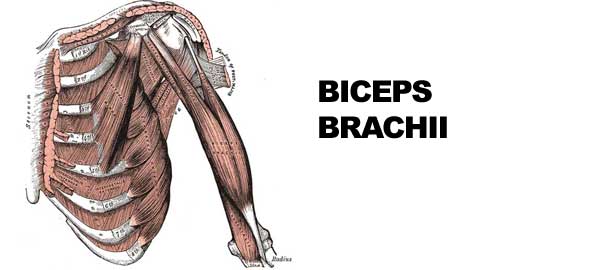
Elbow flexion brings the forearm up at the elbow joint with the wrist and hand in either supinated, pronated or neutral range or any degree in between.
Forward flexion at the glenohumeral joint brings the arm straight up in front of the body in the sagittal plane.
Supination of the forearm at the proximal radioulnar joint rotates the forearm outward as in turning the palm upward or turning the thumb away from the midline of the body.
Lesser Actions:
In Horizontal adduction the biceps brachii helps bring the arms together, as in a dumbbell chest fly.
In Shoulder abduction, the biceps brachii helps raise the arms to the side, as in a standing dumbbell fly or lateral raise.
Read the full story
Posted on 09 January 2009
Tags: muscle

Action:
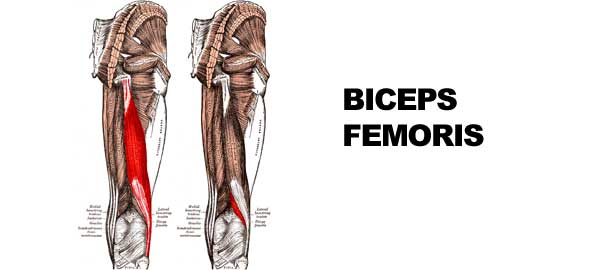
The muscle as a single unit causes both hip extension and knee flexion. Both heads of the Biceps Femoris cause knee flexion. Only the long head of the biceps femoris, which originates in the pelvis — and therefore crosses the hip joint — causes hip extension. The long head of the bicep femoris is a weaker knee flexor when the hip is extended, and a weaker hip extender when the knee is flexed because of active insufficiency. Active insufficiency is the inability to produce maximal measurable tension (actively) because joint angles and levers put a muscle in a slackened position. The slackened position causes a less-than-optimal length-tension relationship of the muscle. Muscles generate less force when overstretched, as when origins and insertions are spread too far, or when the muscles are allowed too much slack, as when origins and insertions get too close. The length-tension relationship is measured from a percentage of 100% resting length of a muscle. The biceps femoris in exercise is an excellent example of active insufficiency, which explains one of the reasons leg curl strength can be stronger in a seated leg curl (hips in flexion) when compared to a prone leg curl on a flat bench (hips in extension). Consider also the effects of standing leg curl machines and prone leg curl machines with slightly flexed body boards.
When the knee is semi flexed, the Biceps femoris has a tendency to rotate the leg slightly outward — external rotation. The external rotation can cause the feet to turn outward and seems to be a common sign of fatigue, visible by observing a walking gait.
Read the full story
Posted on 01 January 2009

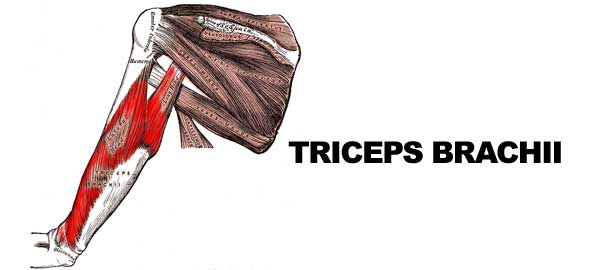
The Triceps Brachii muscle shapes the lateral part of the upper arm and causes elbow extension, which which straightens the arm at the elbow …